
Food Cooking
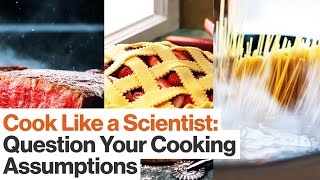
Alton Brown: Cook Like a Scientist by Questioning the Status Quo | Big Think
Added by: Rohan Mehta
What You'll Learn
- Question traditional cooking methods and understand the science behind them to improve your cooking.
- Apply different cooking techniques based on the desired outcome, such as roasting before searing steak.
- Modify recipes by understanding ingredient interactions, like using vodka to reduce gluten formation in pie dough.
Video Breakdown
Alton Brown discusses the importance of questioning accepted cooking rules and traditions to improve food preparation. He uses examples like cooking pasta and searing steak to illustrate how understanding the science behind cooking can lead to better results and encourages viewers to ask 'why' when following recipes.
Key Topics
Questioning Cooking Rules
Pasta Cooking Method
Steak Searing Technique
Understanding Ingredients
Gluten Control
Pie Dough Recipe
Video Index
Challenging Cooking Conventions
This module introduces the core idea of questioning accepted cooking practices and using the word 'w...
This module introduces the core idea of questioning accepted cooking practices and using the word 'why' to understand the reasoning behind them. It highlights examples like pasta cooking and steak searing.
The Importance of 'Why'
0:05 - 0:27
This chapter emphasizes the need to question established cooking rules and the speaker's own evolution in understanding cooking techniques.
Questioning Assumptions
Lack of Imagination
Rethinking Pasta Cooking
0:27 - 0:44
This chapter challenges the traditional method of cooking pasta in large amounts of boiling water, suggesting a more efficient alternative.
Pasta Water
Efficient Cooking
Steak Searing Reimagined
0:44 - 1:19
This chapter introduces the idea of searing steak after cooking, contrary to conventional methods, to achieve better results.
Steak Searing
Cooking Order
Understanding Food
1:19 - 1:33
This chapter emphasizes the importance of understanding the composition of food and how heat affects it.
Food Composition
Heat Application
Applying Scientific Principles to Cooking
This module delves into specific examples of how understanding the science behind cooking can lead t...
This module delves into specific examples of how understanding the science behind cooking can lead to better results. It focuses on steak and pasta preparation.
The Science of Steak
1:47 - 3:12
This chapter explains the scientific principles behind cooking steak, including understanding muscle structure and thermal processes.
Muscle Structure
Thermal Processes
Roasting Then Searing
Pasta Rehydration
3:12 - 4:21
This chapter discusses the science of pasta rehydration and the benefits of starting pasta in cold water.
Pasta Rehydration
Cold Water Start
Al Dente Texture
Hypotheses and Experiments
4:21 - 4:32
This chapter encourages experimentation and hypothesis testing in cooking to achieve better results.
Experimentation
Hypothesis Testing
Ingredient Interactions and Pie Dough
This module focuses on understanding ingredient interactions and provides a specific example of usin...
This module focuses on understanding ingredient interactions and provides a specific example of using vodka in pie dough to control gluten formation.
The Challenge of Pie Dough
4:32 - 4:59
This chapter introduces the difficulty of making pie dough and the importance of learning from experienced bakers.
Pie Dough Difficulty
Learning from Experience
Controlling Gluten Formation
4:59 - 5:23
This chapter discusses the problem of gluten formation in pie dough and the need to control it.
Gluten Formation
Elastic Matrix
The Vodka Solution
5:23 - 6:07
This chapter explains the use of vodka as a liquid in pie dough to reduce gluten formation and improve the dough's texture.
Vodka in Pie Dough
Reduced Gluten
Better Texture
Questions This Video Answers
Why is it important to question cooking rules?
Questioning allows for innovation and better understanding of how food and heat interact, leading to improved cooking techniques and results.
What is the recommended method for searing a steak?
Alton Brown suggests roasting the steak first to cook the interior to the desired doneness, then searing it for a flavorful crust.
Why use vodka in pie dough?
Vodka contains less water than pure water, and the water it does contain binds to the ethanol, reducing gluten formation and resulting in a more tender and easier-to-work-with pie dough.
Related Videos
Want to break down another video?
Break down another video