
Technology
1 Introduction to Quantum Computing and Quantum Algorithms (Mark Laczin)
Added by: David Lin
What You'll Learn
- Understand the fundamental differences between classical bits and qubits and how qubits leverage superposition.
- Learn about the mathematical representation of qubits using Hilbert spaces and Dirac notation.
- Grasp the concepts of quantum measurement, unitary transformations, and the implications of the no-cloning theorem and entanglement.
Video Breakdown
This video provides an introduction to quantum computing and quantum algorithms, starting with the motivation behind quantum computing and then delving into the basics of qubits, superposition, measurement, and unitary transformations. It also covers the no-cloning theorem, entanglement, and Dirac notation, laying the groundwork for understanding more advanced quantum algorithms.
Key Topics
Quantum Computing Motivation
Classical vs. Quantum Bits
Qubit Superposition
Quantum Measurement
Tensor Product
Unitary Transformations
Video Index
Introduction and Motivation
This module introduces the speaker, the motivations for quantum computing, including Moore's Law and...
This module introduces the speaker, the motivations for quantum computing, including Moore's Law and potential algorithmic speedups, and touches on the history of quantum computing proposals.
Welcome and Introduction
0:00 - 0:29
Speaker introduction and overview of the lecture's purpose.
Speaker Introduction
Lecture Overview
Motivation for Quantum Computing
0:29 - 1:13
Discussion of Moore's Law limitations and the need for alternative computing paradigms.
Moore'S Law
Quantum Mechanics
Computational Power
Quantum Speedup and Algorithm Development
1:14 - 1:56
Exploration of the potential for algorithmic speedups with quantum computers and examples of early quantum algorithms.
Quantum Speedup
Shor'S Algorithm
Simon'S Algorithm
Historical Context
1:56 - 2:38
Brief overview of the origins of quantum computing and key figures.
Paul Benioff
Richard Feynman
Quantum Turing Machine
Classical vs. Quantum Bits
This module contrasts classical bits with qubits, highlighting the unique properties of qubits such ...
This module contrasts classical bits with qubits, highlighting the unique properties of qubits such as superposition and entanglement.
Classical Bits
2:39 - 3:13
Explanation of the properties of classical bits and their ease of manipulation.
Shannon Bits
Boolean Logic
Bit Manipulation
Introducing Qubits
3:13 - 4:12
Introduction to qubits and their non-classical properties, including superposition and entanglement.
Qubit Definition
Superposition
Entanglement
Qubit Interaction with Environment
4:12 - 4:23
Discussion of how qubits can become correlated with other qubits and the environment.
Qubit Correlation
Environmental Interaction
Experimental Evidence and Mathematical Formalism
This module presents experimental evidence for quantum phenomena and introduces the mathematical fra...
This module presents experimental evidence for quantum phenomena and introduces the mathematical framework for describing quantum systems, including Hilbert spaces and Dirac notation.
Stern-Gerlach Experiment
4:24 - 6:16
Explanation of the Stern-Gerlach experiment and its implications for understanding quantized spin.
Spin Quantization
Fermions
Spin One-Half Particles
Photon Polarization
6:30 - 7:10
Discussion of photon polarization as another example of quantum behavior.
Photon Polarization
Diffusion Gratings
Quantum Measurement
Qubit Representation and Composite Systems
This module delves into the mathematical representation of qubits using Hilbert spaces and introduce...
This module delves into the mathematical representation of qubits using Hilbert spaces and introduces the concept of tensor products for describing composite quantum systems.
Hilbert Spaces
7:12 - 8:36
Definition and properties of Hilbert spaces as the state space of quantum systems.
Vector Space
Inner Product
Dirac Notation
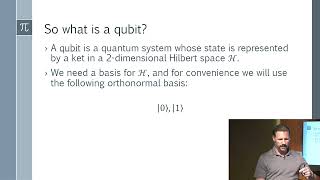
Qubit Definition in Hilbert Space
8:36 - 9:34
Formal definition of a qubit as a vector in a two-dimensional Hilbert space.
Two-Dimensional Hilbert Space
Orthonormal Basis
Qudit
Superposition and Measurement
9:34 - 11:34
Explanation of qubit superposition and the effects of measurement on a qubit's state.
Qubit Superposition
Probability Amplitudes
Measurement Collapse
Concrete Qubit Representation
11:57 - 12:55
Representing qubits as column vectors and introducing the tensor product for multi-qubit systems.
Column Vectors
Tensor Product
Composite Systems
Multi-Qubit Systems and Quantum Evolution
This module discusses the tensor product for describing multi-qubit systems, the concept of unitary ...
This module discusses the tensor product for describing multi-qubit systems, the concept of unitary transformations for evolving quantum states, and examples of common quantum gates.
Tensor Product Application to Qubits
12:56 - 15:37
Applying the tensor product to create multi-qubit systems and representing them as larger matrices.
Multi-Qubit Systems
Matrix Representation
Integer Representation
Superposition of Integer Basis Elements
15:38 - 17:40
Discussing superposition in the context of integer basis elements and the concept of massive parallelism.
Superposition
Basis Elements
Massive Parallelism
Unitary Transformations
17:41 - 18:56
Introducing unitary transformations as the mechanism for evolving quantum systems.
Reversibility
Unitary Operators
Conjugate Transpose
Tensor Product of Operators
18:56 - 20:13
Applying tensor products to combine operators acting on multiple qubits.
Operator Combination
Entanglement
Lie Algebra
Quantum Gates, No-Cloning Theorem, and Measurement
This module covers common quantum gates, the no-cloning theorem, and the implications of measurement...
This module covers common quantum gates, the no-cloning theorem, and the implications of measurement in quantum mechanics, including entanglement and spooky action at a distance.
Classic Quantum Operators
20:14 - 21:54
Introduction to common quantum operators like the Hadamard and NOT gates.
Hadamard Transform
NOT Gate
Tensor Product Example
Why Unitary Transformations?
21:54 - 22:59
Explanation of why unitary transformations are necessary based on the Schrodinger equation.
Schrödinger Equation
Hamiltonian
Wigner'S Theorem
No-Cloning Theorem
22:59 - 26:11
Proof and implications of the no-cloning theorem.
Cloning Impossibility
Unitary Contradiction
Inner Product Proof
Measurement and Entanglement
26:12 - 29:49
Discussion of measurement outcomes, entanglement, and the Einstein-Podolsky-Rosen (EPR) paradox.
Probability Amplitudes
Entangled States
EPR Pairs
Local Realism
Dirac Notation, Measurement Details, and Conclusion
This module concludes with a discussion of Dirac notation, further details on projective measurement...
This module concludes with a discussion of Dirac notation, further details on projective measurements, and a summary of the key concepts covered in the lecture.
Dirac Notation
29:50 - 32:03
Explanation of Dirac notation (bra-ket notation) and its use in quantum mechanics.
Ket Vectors
Bra Vectors
Outer Product
Projective Measurements
32:04 - 34:46
Detailed explanation of projective measurements and their construction using outer products.
Hermitian Operator
Eigen Space
Spectral Decomposition
Computational Basis
Summary and Outlook
34:47 - 37:06
Recap of the key concepts and an outlook on future topics, including quantum algorithms.
Qubit Properties
Reversibility
No-Cloning Theorem
Quantum Algorithms
Questions This Video Answers
What is the primary motivation for exploring quantum computing?
The primary motivations are overcoming the limitations of Moore's Law as transistors reach quantum scales and the potential for quantum speedup in certain algorithmic tasks.
What is a qubit, and how does it differ from a classical bit?
A qubit is the basic unit of quantum information. Unlike classical bits, which are either 0 or 1, a qubit can exist in a superposition of both states simultaneously.
Why is the no-cloning theorem important in quantum computing?
The no-cloning theorem states that an arbitrary quantum state cannot be perfectly copied. This has implications for quantum cryptography and error correction.
What is quantum entanglement, and why is it significant?
Quantum entanglement is a phenomenon where two or more qubits become correlated in such a way that the state of one qubit instantaneously influences the state of the others, regardless of the distance separating them. It's a key resource for quantum computation and communication.
What are unitary transformations, and why are they important for quantum computation?
Unitary transformations are reversible operations that preserve the norm of quantum states. They are crucial for evolving quantum systems and performing quantum computations because they ensure that probabilities remain consistent.
How does measurement affect a qubit's state?
Measurement causes a qubit to collapse from a superposition into one of its basis states (0 or 1). The probability of collapsing into a particular state is determined by the square of the magnitude of the corresponding probability amplitude.
Related Videos
Want to break down another video?
Break down another video