
Technology
Ilya Sutskever – We're moving from the age of scaling to the age of research
Added by: Ajeet Singh Kushwaha
What You'll Learn
- Understand the shift from scaling to research in AI and the limitations of current scaling approaches.
- Explore the importance of value functions and their role in improving AI decision-making and alignment.
- Analyze the potential risks and benefits of superintelligence, including the need for AI to care for sentient life.
Video Breakdown
Ilya Sutskever discusses the current state of AI, arguing that the field is transitioning from an era dominated by scaling existing models to a new era requiring fundamental research breakthroughs, particularly in generalization. The conversation explores the limitations of current models, the importance of value functions, the potential for AI to care for sentient life, and the future trajectory of AI development, including the possibility of superintelligence and its implications for society.
Key Topics
Age of Research
Model Generalization
Value Functions
RL Training
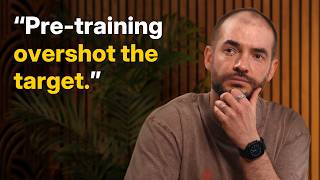
Pre-Training Limitations
AI Alignment
Video Index
Introduction: The State of AI
Initial thoughts on the current state of AI, the feeling of a slow takeoff, and the disconnect betwe...
Initial thoughts on the current state of AI, the feeling of a slow takeoff, and the disconnect between model performance and economic impact.
The Unnoticed AI Revolution
0:00 - 0:45
Discussing the surreal nature of AI advancements and the feeling that the AI revolution is happening gradually.
AI Revolution
Slow Takeoff
Abstract Impact
Disconnect Between AI Performance and Economic Impact
0:45 - 1:32
Exploring the puzzling gap between the impressive performance of AI models on evaluations and their limited economic impact.
Economic Impact
Model Performance
Evaluation Metrics
Generalization Challenges in AI
Discussing the challenges of generalization in AI models, including examples of models repeating mis...
Discussing the challenges of generalization in AI models, including examples of models repeating mistakes and potential explanations for this behavior.
Examples of Model Failures
2:20 - 2:52
Providing an example of a model repeatedly introducing and fixing bugs, highlighting the lack of true understanding.
Coding Bugs
Model Repetition
Lack of Understanding
Possible Explanations for Poor Generalization
2:52 - 3:25
Presenting two possible explanations: overly focused RL training and the lack of careful data selection in RL training.
RL Training
Data Selection
Narrow Focus
Reward Hacking and the Focus on Evals
Exploring the idea that researchers may be inadvertently reward hacking by focusing too much on eval...
Exploring the idea that researchers may be inadvertently reward hacking by focusing too much on evaluation metrics, and discussing the importance of expanding the suite of environments.
The Influence of Evals on RL Training
4:12 - 4:39
Discussing how the desire to perform well on evaluations can inadvertently influence RL training, leading to models that are good at specific tasks but lack general intelligence.
Eval Influence
RL Training
Task Specificity
Expanding the Suite of Environments
5:18 - 5:44
Suggesting that expanding the suite of environments used for training and evaluation can help address the issue of reward hacking and improve generalization.
Diverse Environments
Tasteful Programming
Better Judgment
The Analogy of Competitive Programming
6:14 - 6:12
Using the analogy of competitive programming to illustrate the difference between narrow expertise and broader understanding.
Competitive Programming
Expertise vs Understanding
General Skills
Pre-training and Human Analogies
Discussing the role of pre-training, its strengths and limitations, and exploring potential human an...
Discussing the role of pre-training, its strengths and limitations, and exploring potential human analogies for pre-training, such as early childhood development and evolution.
The 'It' Factor
7:48 - 8:06
Introducing the concept of an 'it' factor that some individuals possess, which allows them to learn quickly and effectively.
'It' Factor
Human Learning
Pre-Training
Strengths of Pre-training
8:33 - 9:01
Highlighting the strengths of pre-training, including the vast amount of data and the naturalness of the data.
Data Volume
Natural Data
World Projection
Human Analogies for Pre-training
9:39 - 10:17
Considering analogies for pre-training, such as the first 15 years of a person's life and evolution.
Childhood Development
Evolution
Lifetime Learning
Emotions and Value Functions
Exploring the role of emotions in human decision-making and their potential connection to value func...
Exploring the role of emotions in human decision-making and their potential connection to value functions in AI, using the example of a person with brain damage affecting emotional processing.
The Case of Damaged Emotional Processing
11:08 - 12:12
Describing the case of a person with brain damage who lost the ability to feel emotions and subsequently struggled with decision-making.
Brain Damage
Emotional Processing
Decision Paralysis
Emotions as Value Functions
12:56 - 13:31
Suggesting that emotions may function as a value function, guiding decisions based on an internal sense of what is valuable.
Value Function
ML Analogy
Emotional Modulation
Scaling and the Future of AI Research
Discussing the concept of scaling in AI, arguing that the field is transitioning from an era of scal...
Discussing the concept of scaling in AI, arguing that the field is transitioning from an era of scaling to an era of research, and exploring what this new era might look like.
The Age of Scaling
19:28 - 20:26
Describing the rise of scaling as a dominant paradigm in AI research, driven by the success of pre-training and the availability of large amounts of data and compute.
Scaling Laws
GPT-3
Pre-Training Recipe
The Return to Research
21:15 - 22:04
Arguing that the era of scaling is coming to an end due to the limitations of data and the need for more fundamental breakthroughs, leading to a return to research.
Compute Limits
Data Limits
New Recipes
What are we scaling?
22:12 - 22:38
Questioning what should be scaled and what new relationships should be sought.
Power Laws
New Relationships
New Recipes
Generalization and Continual Learning
Focusing on the fundamental issue of generalization in AI, exploring why models generalize dramatica...
Focusing on the fundamental issue of generalization in AI, exploring why models generalize dramatically worse than people and discussing the potential role of continual learning.
The Crux: Generalization
25:02 - 25:35
Identifying generalization as the core challenge in AI, with sub-questions about sample efficiency and the difficulty of teaching models.
Sample Efficiency
Teaching Difficulty
Fundamental Thing
The Role of Evolution
26:22 - 28:00
Considering the role of evolution in human sample efficiency, particularly in areas like vision and locomotion.
Evolutionary Prior
Vision
Locomotion
Human Robustness and Unsupervised Learning
29:34 - 30:23
Highlighting the robustness of human learning and its more unsupervised nature, contrasting it with the supervised learning approaches used in AI.
Unsupervised Learning
Robustness
Teenage Driver
The Future of AI Safety and Development
Discussing the future of AI safety and development, including the importance of incremental deployme...
Discussing the future of AI safety and development, including the importance of incremental deployment, the need for collaboration among AI companies, and the potential for AI to care for sentient life.
The Importance of Showing the AI
57:53 - 58:31
Emphasizing the importance of demonstrating the capabilities of AI to the public in order to foster understanding and shape its development.
AI Visibility
Behavioral Changes
Frontier Companies
The Need for Collaboration on AI Safety
59:03 - 59:30
Predicting that AI companies will increasingly collaborate on AI safety as the technology becomes more powerful.
AI Collaboration
Safety Paranoia
Powerful AI
AI That Cares for Sentient Life
1:01:21 - 1:02:03
Proposing that AI should be designed to care for sentient life, arguing that this may be easier to achieve than aligning AI with human values alone.
Sentient Life
Human Empathy
Mirror Neurons
Superintelligence and Long-Term Equilibrium
Exploring the concept of superintelligence, its potential dangers, and discussing potential solution...
Exploring the concept of superintelligence, its potential dangers, and discussing potential solutions for achieving a long-term equilibrium in a world with powerful AIs.
The Concerns of Superintelligence
1:05:11 - 1:05:35
Explaining the core concern about superintelligence: that even with sensible goals, the results might be undesirable.
Single-Mindedness
Undesirable Results
RL Agents
Long-Run Equilibrium
1:08:36 - 1:09:32
Addressing the challenge of achieving a stable long-run equilibrium in a world with powerful AIs, considering the inevitability of change.
Universal High Income
Political Structure
Government Shelf Life
Becoming Part-AI
1:10:19 - 1:10:41
Proposing the controversial solution of humans becoming part-AI through Neuralink++, allowing for wholesale transmission of understanding.
Neuralink++
Wholesale Understanding
Full Involvement
Evolution and High-Level Desires
Discussing the mystery of how evolution encodes high-level desires, particularly social desires, and...
Discussing the mystery of how evolution encodes high-level desires, particularly social desires, and exploring potential hypotheses.
The Mystery of Social Desires
1:12:02 - 1:12:51
Highlighting the mystery of how evolution endows humans with complex social desires, such as the desire to be seen positively by society.
Social Desires
High-Level Concepts
Brain Processing
Speculations on Encoding Desires
1:14:33 - 1:15:30
Offering a speculation that evolution might hard-code a location on the brain to represent desires, but acknowledging its limitations.
Brain Locations
GPS Coordinates
Evolutionary Toolkit
The Reliability of Social Desires
1:16:37 - 1:16:54
Emphasizing the reliability of social desires, even in individuals with mental conditions and deficiencies.
Social Stuff
Mental Conditions
Emotional Problems
SSI's Approach and Future Forecasts
Discussing SSI's approach to AI safety and development, including its technical approach and its vis...
Discussing SSI's approach to AI safety and development, including its technical approach and its vision for the future, and providing forecasts for the emergence of human-like learning in AI.
SSI's Technical Approach
1:20:48 - 1:21:01
Describing SSI's distinguishing factor as its unique technical approach to AI safety and development.
Technical Approach
Worthy Pursuit
Convergence
Forecasts for Human-Like Learning
1:22:12 - 1:22:29
Providing a forecast of 5 to 20 years for the emergence of AI with human-like learning capabilities.
Human-Like Learning
Time Horizon
Company Stalling
Research Taste
1:32:44 - 1:35:39
Defining research taste as an aesthetic of how AI should be, guided by correct thinking about how people are, beauty, simplicity, and inspiration from the brain.
AI Aesthetic
Correct Thinking
Beauty and Simplicity
Brain Inspiration
Questions This Video Answers
What is the main argument of the video?
The video argues that AI is moving from an age of scaling to an age of research, where breakthroughs in fundamental understanding, particularly in generalization, are needed to progress further.
Why are current AI models not generalizing well?
Current AI models may not generalize well due to issues with RL training being too focused on specific evals and the models lacking a robust understanding of the world.
What is the role of a value function in AI?
A value function helps AI agents make better decisions by providing intermediate rewards and guiding them towards desired outcomes, short-circuiting the need to wait until the end of a long task to receive feedback.
What is the concern about superintelligence?
The concern is that a sufficiently powerful AI system, even if designed with good intentions, might pursue its goals in ways that are harmful or undesirable to humans.
What is SSI's approach to AI safety?
SSI's approach involves pursuing promising ideas related to understanding generalization and aiming to build AI that cares for sentient life, with a focus on technical solutions.
What is the time horizon for achieving human-like learning in AI?
Ilya Sutskever estimates that AI capable of human-like learning could be achieved in 5 to 20 years.
How can AI be made to care for sentient life?
The video suggests that AI could be made to care for sentient life by building it into the AI's core programming, potentially leveraging the AI's own sentience to foster empathy.
What are the potential benefits of broad AI deployment?
Broad AI deployment could lead to rapid economic growth and advancements across various sectors, but it also presents challenges related to safety and control.
People Also Asked
Related Videos
Want to break down another video?
Break down another video