Business Finance
William Ackman: Everything You Need to Know About Finance and Investing in Under an Hour | Big Think
Creator: Big Think
What You'll Learn
- Understand the fundamental financial statements (balance sheet, income statement, cash flow statement) and how they reflect a company's performance.
- Apply key principles for successful long-term investing, including starting early, avoiding losses, and focusing on understandable businesses with sustainable competitive advantages.
- Navigate the psychological challenges of investing and make rational decisions, even during market volatility.
Video Breakdown
Bill Ackman provides an overview of finance and investing, starting with a lemonade stand business to illustrate key concepts like balance sheets, income statements, and cash flow. He then discusses principles for successful investing, including starting early, avoiding losses, and investing in understandable, long-term businesses, and offers advice on navigating the psychology of the stock market and selecting mutual funds.
Key Topics
Financial Statements
Business Valuation
Debt vs. Equity
Risk Assessment
Compounding Returns
Public Offerings (IPO)
Video Index
Building a Business: The Lemonade Stand Example
This module uses a lemonade stand as a practical example to explain basic business concepts, includi...
This module uses a lemonade stand as a practical example to explain basic business concepts, including forming a corporation, raising capital, understanding financial statements, and projecting future performance.
Starting the Lemonade Stand
0:33 - 3:06
Covers the initial steps of starting a business, including raising capital through stock and debt, and understanding the initial balance sheet.
Raising Capital
Stock Issuance
Debt Financing
Initial Balance Sheet
Operating the Business: Initial Performance
3:06 - 6:00
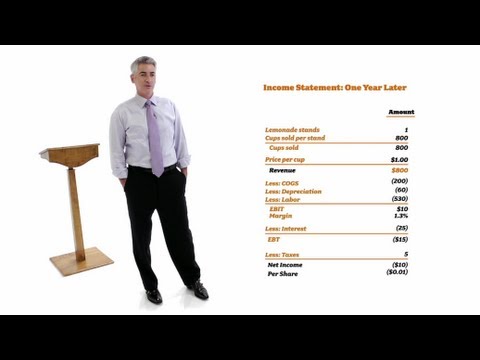
Explores the operational aspects of the lemonade stand, including fixed assets, inventory, and the initial income statement and cash flow statement, revealing a loss in the first year.
Fixed Assets
Inventory Management
Income Statement
Cash Flow Statement
Projecting Future Growth
6:00 - 8:49
Demonstrates how to project future growth by reinvesting profits, increasing prices, and expanding operations, leading to significant profitability by year five.
Business Projections
Revenue Growth
Profit Margins
Shareholder Equity
Analyzing Business Quality and Risk
This module discusses how to evaluate whether a business is good or bad, focusing on return on capit...
This module discusses how to evaluate whether a business is good or bad, focusing on return on capital, the difference between debt and equity, and how to assess risk.
Good vs. Bad Businesses
8:49 - 11:11
Explains how to evaluate a business based on its earnings compared to invested capital and the difference in risk and return between debt and equity investors.
Return on Capital
Earnings Growth
Profitability
Debt vs. Equity
Understanding Debt and Equity
11:11 - 13:03
Delves into the characteristics of debt and equity, highlighting the safer nature of debt with limited profit potential versus the higher risk and potential return of equity.
Debt Priority
Equity Residual Claim
Risk vs. Reward
Lender vs. Stockholder
Assessing Investment Risk
13:03 - 14:52
Focuses on defining risk as the potential for permanent loss of capital and comparing investment risk to alternatives like government bonds.
Permanent Loss
Risk Alternatives
Treasury Bonds
Equity Investor Returns
Raising Capital and Valuation
This module covers different methods for raising capital, including selling the company, paying divi...
This module covers different methods for raising capital, including selling the company, paying dividends, and taking the business public through an IPO. It also introduces the concept of business valuation.
Raising Capital Options
14:52 - 17:56
Explores various options for raising capital, including paying dividends, selling the company, and selling a private interest.
Dividend Payments
Company Sale
Private Investment
Growth vs. Dividends
Taking a Business Public (IPO)
17:56 - 20:26
Explains the process of taking a business public through an IPO, including the role of lawyers, investment banks, and the prospectus.
IPO Process
Prospectus Creation
SEC Review
Public Offering
Investing Principles and Psychology
This module provides advice on how to be a successful investor, emphasizing the importance of starti...
This module provides advice on how to be a successful investor, emphasizing the importance of starting early, avoiding losses, and investing in understandable businesses. It also addresses the psychology of investing and the impact of compounding.
Business Valuation
20:26 - 22:40
Explains how to value a business by comparing it to similar businesses and using multiples of earnings.
Comparable Companies
Earnings Multiples
Market Valuation
Share Price
Keys to Successful Investing: Start Early
22:40 - 25:12
Highlights the power of compounding and the importance of starting to invest early to maximize long-term returns.
Compounding Returns
Early Investment
Long-Term Growth
Retirement Planning
The Power of Compounding and Avoiding Losses
25:12 - 28:39
Emphasizes the impact of compounding returns over time and the critical importance of avoiding significant losses to achieve long-term investment success.
Compounding Power
Avoiding Losses
Warren Buffett'S Rules
Long-Term Wealth
Practical Investment Advice and Mutual Funds
This module provides practical advice on where to invest, what to look for in a business, and how to...
This module provides practical advice on where to invest, what to look for in a business, and how to select mutual funds. It also covers the psychology of investing and the importance of diversification.
Where to Invest: Key Criteria
28:39 - 39:25
Offers specific criteria for selecting investments, including focusing on public securities, understandable businesses, low debt, and barriers to entry.
Public Companies
Business Understanding
Low Debt
Barriers to Entry
The Psychology of Investing
39:25 - 43:02
Addresses the psychological challenges of investing, such as following the herd and reacting to market volatility, and offers advice on how to overcome these challenges.
Market Volatility
Emotional Control
Long-Term Perspective
Financial Security
Mutual Funds and Diversification
43:02 - 45:27
Explains what mutual funds are and provides key success factors for selecting a good mutual fund manager, including integrity, a value-oriented approach, and a long-term track record.
Mutual Fund Selection
Value Investing
Manager Integrity
Diversification
Finance in Our Lives
This module summarizes the key concepts covered in the lecture and emphasizes the importance of fina...
This module summarizes the key concepts covered in the lecture and emphasizes the importance of financial literacy for making informed decisions in various aspects of life.
Summary and Recommendations
45:27 - 46:02
Recaps the main points of the lecture and encourages viewers to continue learning about finance and investing to improve their quality of life.
Financial Literacy
Continuous Learning
Informed Decisions
Quality of Life
Questions This Video Answers
What are the key financial statements and what do they tell you?
The key financial statements are the balance sheet (assets, liabilities, equity), the income statement (revenues, expenses, profits), and the cash flow statement (cash inflows and outflows). They provide a snapshot of a company's financial health and performance.
Why is it important to start investing early?
Starting early allows you to take advantage of the power of compounding, where your returns generate further returns over time, leading to exponential growth of your investments.
What are some characteristics of a good business to invest in for the long term?
A good business to invest in has understandable operations, a long track record of success, a unique product or service, low debt, barriers to entry, and is relatively immune to external economic factors.
How can you manage the psychological challenges of investing?
By being financially secure, understanding the difference between short-term market fluctuations and long-term business value, and doing your own research to gain confidence in your investment decisions.
What should you look for when selecting a mutual fund?
Look for a fund with an understandable investment strategy, a manager with a reputation for integrity and a long-term track record, a value-oriented approach, and a manager who invests their own money alongside yours.
What is an IPO and how does it work?
An IPO (Initial Public Offering) is when a private company sells shares to the public for the first time, allowing them to raise capital and become listed on a stock exchange. The company prepares a prospectus detailing its business, risks, and financial performance.
Related Videos
Want to break down another video?
Break down another video