
Technology
Digital Design Interview Questions | Combinational, Sequential, Clock Gating | Tasks | Functions
Creator: Flop_n_Adder
What You'll Learn
- Differentiate between combinational and sequential logic circuits, understanding their characteristics and applications.
- Explain clock gating and its benefits for power management in digital circuits, including its implementation and potential challenges.
- Distinguish between Verilog tasks and functions, outlining their syntax, capabilities, and appropriate use cases in digital design.
Video Breakdown
This video explains the differences between combinational and sequential logic, clock gating techniques for power management, and the distinction between Verilog tasks and functions. It provides Verilog code examples and discusses the benefits and challenges of each concept, offering valuable insights for digital design interviews.
Key Topics
Combinational vs Sequential
Clock Gating Technique
Dynamic Power Reduction
Verilog Task
Verilog Function
Timing Considerations
Video Index
Combinational vs. Sequential Logic
This module defines and differentiates combinational and sequential logic circuits, providing Verilo...
This module defines and differentiates combinational and sequential logic circuits, providing Verilog examples and highlighting their key differences in terms of output dependency, clock usage, memory, speed, and design complexity.
Understanding Combinational Logic
0:18 - 0:55
This chapter explains combinational logic circuits, their characteristics, and provides a Verilog code example.
Logic Gates
Current Inputs
No Clock
Understanding Sequential Logic
0:55 - 1:24
This chapter explains sequential logic circuits, their characteristics including memory, and provides a Verilog code example.
Memory Elements
Past Inputs
Flip-Flops
Key Differences Summarized
1:24 - 3:07
This chapter summarizes the key differences between combinational and sequential logic circuits across various aspects.
Output Dependency
Clock Presence
Memory
Examples
Clock Gating for Power Management
This module introduces clock gating as a power management technique, explaining its implementation, ...
This module introduces clock gating as a power management technique, explaining its implementation, benefits in reducing dynamic power dissipation, and the considerations for its use in digital circuit design.
Introduction to Clock Gating
3:07 - 3:49
This chapter introduces the concept of clock gating and its role in reducing power consumption.
Power Reduction
Switching Activity
Idle Circuits
Clock Gating Implementation
3:49 - 4:49
This chapter explains the implementation of clock gating with Verilog code and waveforms.
Verilog Code
Clock Enable
Gated Clock
Benefits and Challenges
4:49 - 6:03
This chapter discusses the benefits and challenges of implementing clock gating in digital designs.
Power Savings
Timing Impact
Verification
Verilog Tasks vs. Functions
This module explains the differences between Verilog tasks and functions, covering their syntax, cap...
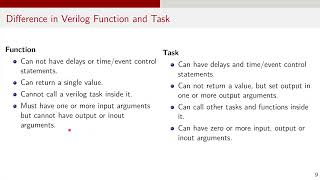
This module explains the differences between Verilog tasks and functions, covering their syntax, capabilities, and appropriate use cases, including examples and a summary of their key distinctions.
Understanding Verilog Functions
6:10 - 8:12
This chapter explains Verilog functions, their syntax, and limitations.
Return Value
Input Arguments
No Delays
Understanding Verilog Tasks
8:12 - 10:01
This chapter explains Verilog tasks, their syntax, and capabilities.
Output Arguments
Timing Delays
Complex Operations
Key Differences Summarized
10:01 - 10:53
This chapter summarizes the key differences between Verilog tasks and functions.
Timing Control
Return Value
Task Calling
Argument Types
Questions This Video Answers
What is the key difference between combinational and sequential logic?
Combinational logic's output depends solely on current inputs, while sequential logic's output depends on both current and past inputs, incorporating memory elements.
How does clock gating reduce power consumption?
Clock gating disables the clock signal to idle parts of a circuit, preventing unnecessary switching and reducing dynamic power dissipation.
When should I use a Verilog task versus a function?
Use functions for simple combinational logic with a single return value and no timing delays. Use tasks for more complex operations with timing delays, multiple outputs, or the need to call other tasks.
What are the benefits of clock gating?
Clock gating reduces dynamic power consumption, is scalable, and improves digital design efficiency.
Related Videos
Want to break down another video?
Break down another video