Education
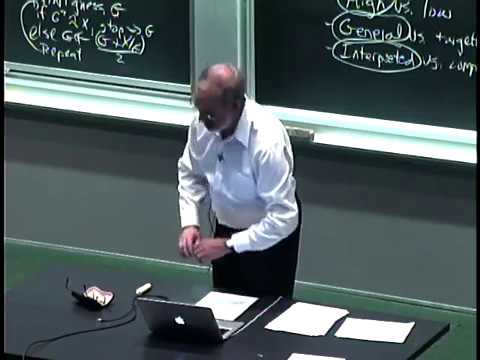
Lec 1 | MIT 6.00 Introduction to Computer Science and Programming, Fall 2008
Creator: MIT OpenCourseWare
What You'll Learn
- Understand the strategic and tactical goals of the 6.00 Introduction to Computer Science and Programming course.
- Differentiate between declarative and imperative knowledge and how they relate to computation.
- Begin to grasp the basics of Python syntax, data types (numbers and strings), and operators.
Video Breakdown
This lecture serves as an introduction to MIT's 6.00 Introduction to Computer Science and Programming course. Professors Eric Grimson and John Guttag outline the course's strategic and tactical goals, discuss administrative details, and begin to explore the fundamental concepts of computation, imperative knowledge, and the role of programming languages like Python in problem-solving.
Key Topics
Course Goals
Computational Thinking
Imperative Knowledge
Stored-Program Computer
Programming Languages
Python Basics
Video Index
Course Introduction and Goals
Introduction to the course, instructors, and the strategic goals for students with and without prior...
Introduction to the course, instructors, and the strategic goals for students with and without prior programming experience.
Instructor Introductions
0:17 - 1:03
Introduction of Professors Eric Grimson and John Guttag, highlighting their experience and commitment to the course.
Eric Grimson
John Guttag
Teaching Experience
Strategic Course Goals
1:03 - 3:10
Explanation of the course's strategic goals for both course six majors and non-majors, focusing on building confidence and competence in computational problem-solving.
Course Six Majors
Non-Majors
Computational Problem Solving
Internship Preparation
Tactical Skills and Course Administration
Detailed explanation of the skills students will acquire and the administrative aspects of the cours...
Detailed explanation of the skills students will acquire and the administrative aspects of the course, including quizzes, problem sets, and resources.
Acquired Skills
4:26 - 6:37
Description of the skills students will gain, including writing small programs, understanding code, recognizing computation limits, and mapping problems into a computational frame.
Computational Thinking
Code Reading
Computation Limits
Problem Mapping
Administrative Details
7:11 - 7:20
Overview of the course structure, including lecture times, recitation schedules, and outside-of-class work expectations.
Lecture Schedule
Recitation Schedule
Problem Sets
Python
Course Policies and Expectations
Detailed explanation of course policies, grading, resources, and expectations for student behavior a...
Detailed explanation of course policies, grading, resources, and expectations for student behavior and engagement.
Grading and Assignments
9:34 - 11:17
Breakdown of the grading percentages for problem sets, quizzes, and the final exam, along with the intention behind the problem sets.
Grading Percentages
Problem Set Purpose
Seeking Help
Resources and Recitations
11:18 - 12:34
Information about the course website, recitation sign-ups, and the lack of a required textbook.
Course Website
Recitation Sign-up
Recommended Text
Attendance and Note-Taking
12:34 - 14:32
Discussion of attendance policies, the importance of note-taking, and the availability of staff for assistance.
Attendance Policy
Note-Taking
Staff Assistance
OpenCourseWare and Recitation Importance
15:34 - 16:14
Additional notes about the video recording for OpenCourseWare and the importance of attending recitations.
Opencourseware Recording
Recitation Attendance
Introduction to Computation
Exploration of what it means to think like a computer scientist, the nature of computation, and the ...
Exploration of what it means to think like a computer scientist, the nature of computation, and the difference between declarative and imperative knowledge.
Computational Thinking and Knowledge
16:14 - 18:20
Defining computational thinking and dividing knowledge into declarative (facts) and imperative (how-to) categories.
Computational Thinking
Declarative Knowledge
Imperative Knowledge
Imperative Knowledge Example
18:20 - 21:27
Providing an example of imperative knowledge with Heron's method for computing square roots.
Heron'S Method
Square Root Algorithm
Recipe Description
Mechanical Computation
21:37 - 23:58
Discussing mechanical processes for capturing computation, including fixed-program computers and their limitations.
Fixed-Program Computers
Calculators
Atanasoff Computer
Turing'S Bombe
Stored-Program Computers and Programming Languages
Explaining stored-program computers, the role of interpreters, and introducing the concept of progra...
Explaining stored-program computers, the role of interpreters, and introducing the concept of programming languages, particularly Python.
Stored-Program Concept
23:58 - 26:10
Introducing the concept of a stored-program computer and how it differs from fixed-program computers.
Stored-Program Computer
Interpreter
Recipe Input
Computer Architecture
26:10 - 28:58
Describing the basic architecture of a stored-program computer, including memory, control unit, ALU, and program counter.
Memory
Control Unit
ALU
Program Counter
Programming Languages
28:58 - 31:50
Explaining that a program is a recipe and that with a fixed set of primitives, a programmer can program anything.
Program as Recipe
Turing'S Primitives
Turing Compatibility
Python Introduction
31:50 - 36:41
Introducing the concept of programming languages and why Python is used in the course.
Programming Language Choice
Python
Matlab
C
Lisp
Language Dimensions and Syntax vs Semantics
Discussing the dimensions of programming languages (high-level vs. low-level, general vs. targeted, ...
Discussing the dimensions of programming languages (high-level vs. low-level, general vs. targeted, interpreted vs. compiled) and the concepts of syntax and semantics.
Language Dimensions
36:41 - 38:11
Describing the three dimensions of programming languages: high-level vs. low-level, general vs. targeted, and interpreted vs. compiled.
High-Level Language
Low-Level Language
Interpreted Language
Compiled Language
Syntax vs Semantics
38:58 - 41:10
Explaining the difference between syntax (legal expressions) and semantics (meaning of expressions) in a programming language.
Syntax
Semantics
Static Semantics
Full Semantics
Error Handling and Style
41:10 - 45:02
Discussing how Python handles syntax and semantic errors, and the importance of developing good programming style.
Syntax Errors
Semantic Errors
Programming Style
Python Basics: Values, Types, and Operators
Introduction to basic Python elements, including values (numbers and strings), data types, operators...
Introduction to basic Python elements, including values (numbers and strings), data types, operators, and variables.
Primitive Data Types
45:02 - 46:17
Introducing primitive data types in Python: numbers (integers and floats) and strings.
Numbers
Integers
Floats
Strings
Python Shell and Expressions
46:17 - 48:52
Demonstrating how to use the Python shell to type in expressions and get back values.
Python Shell
Expressions
Interpreter
Operators and Static Semantics
48:52 - 51:14
Showing examples of operators and static semantic errors, including type mismatches.
Operators
Static Semantics
Type Errors
String Multiplication
Numeric Operations and Variables
51:14 - 53:27
Demonstrating numeric operations (division, multiplication, addition) and introducing variables to store values.
Numeric Operations
Integer Division
Float Division
Variables
String Concatenation
Questions This Video Answers
What are the strategic goals of the 6.00 course?
The strategic goals include preparing students for course six majors, enabling non-majors to confidently write and read small pieces of code, providing an understanding of computation's role in problem-solving, and positioning students for internships and jobs.
What is the difference between declarative and imperative knowledge?
Declarative knowledge is a statement of fact or definition, while imperative knowledge is a description of how to deduce something, a recipe or a sequence of steps.
Why is Python used in this course?
Python is used as a tool to help students learn computational thinking and design recipes for problem-solving. The course is not about Python itself, but about using it to develop transferable skills.
What are the key components of a stored-program computer?
A stored-program computer includes memory, a control unit, an arithmetic logic unit (ALU), and a program counter. The program counter points to the current instruction in memory, and the instructions are executed sequentially.
What is the difference between syntax and semantics in a programming language?
Syntax refers to the legal expressions in a language, while semantics refers to the meaning of those expressions. Static semantics checks if programs are meaningful, and full semantics describes what happens when a program is run.
What are the three dimensions of a programming language discussed in the lecture?
The three dimensions discussed are: high-level vs. low-level, general vs. targeted, and interpreted vs. compiled.
Related Videos
Want to break down another video?
Break down another video