
What You'll Learn
- How local AI agents like OpenClaw differ from cloud-based AI solutions and why this difference is significant.
- The potential for AI agents to replace many existing apps by automating tasks and managing data more naturally.
- The importance of data ownership and control in the age of personal AI agents.
Video Breakdown
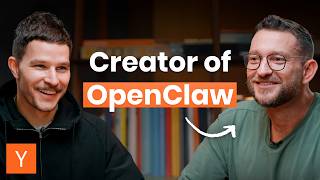
This video features a conversation with Peter Steinberger, the creator of OpenClaw, an open-source personal AI agent. They discuss the reasons for OpenClaw's rapid success, its unique capabilities compared to cloud-based AI, and the potential future impact of personal AI agents on app development and human-computer interaction.
Key Topics
Personal AI Agents
Local vs Cloud AI
Bot-to-Bot Interaction
App Disruption
AI Model Commoditization
Data Ownership
Video Index
Introduction to OpenClaw and its Impact
This module introduces Peter Steinberger and OpenClaw, highlighting its rapid growth and the unique ...
This module introduces Peter Steinberger and OpenClaw, highlighting its rapid growth and the unique capabilities that set it apart from other AI assistants.
OpenClaw's Initial Success
0:00 - 0:25
Overview of OpenClaw's rapid adoption and community projects.
Github Stars
Community Projects
Peter's Reaction to OpenClaw's Popularity
0:50 - 1:30
Peter discusses the overwhelming response and the need for solitude.
Overwhelming Response
Need for Solitude
Key Differentiators: Local vs. Cloud AI
This module explores the core difference between OpenClaw and other AI assistants, focusing on the b...
This module explores the core difference between OpenClaw and other AI assistants, focusing on the benefits of running AI locally on your computer.
The Power of Local Execution
1:30 - 2:00
Explanation of why running AI locally provides more power and control.
Local Control
Device Connectivity
Real-World Task Automation
1:55 - 2:30
Examples of how OpenClaw can automate tasks by accessing local data and devices.
Oven Control
Tesla Integration
Bot-to-Bot and Bot-to-Human Interactions
2:54 - 4:00
Discussion on the future of AI interactions, including bots negotiating with other bots and hiring humans for real-world tasks.
Bot Negotiation
Human Task Delegation
Specialist Bots
The 'Aha' Moment and OpenClaw's Development
This module delves into the moment Peter realized the true potential of OpenClaw and the development...
This module delves into the moment Peter realized the true potential of OpenClaw and the development process that led to its creation.
The Initial Need and Previous Attempts
5:11 - 5:40
Peter's initial desire for a tool to automate computer tasks and his earlier attempts.
Task Automation
Previous Iterations
The Summarization Project
6:10 - 6:30
The project Peter was working on when the need for OpenClaw resurfaced.
CLI App
Podcast Summarization
WhatsApp Integration and Unexpected Capabilities
7:41 - 7:50
The moment Peter realized OpenClaw's ability to solve problems he hadn't explicitly programmed it for.
Whatsapp Integration
Image Processing
The Future of Apps and AI Models
This module explores the potential disruption of the app ecosystem by AI agents and the commoditizat...
This module explores the potential disruption of the app ecosystem by AI agents and the commoditization of AI models.
The Decline of Traditional Apps
10:34 - 11:36
Discussion on why many apps may become obsolete due to the capabilities of AI agents.
App Redundancy
AI-Driven Automation
The Commoditization of AI Models
12:20 - 13:20
Analysis of how AI models are becoming increasingly commoditized and the implications for the industry.
Model Leapfrogging
Open-Source Alternatives
Data Ownership and Silos
13:38 - 14:40
The importance of data ownership and the challenges posed by data silos created by different companies.
Data Ownership
Data Silos
Privacy Concerns
Development Philosophy and the 'Soul.md' File
This module covers Peter's unique approach to development, including his preference for certain mode...
This module covers Peter's unique approach to development, including his preference for certain models and tools, and the significance of the 'soul.md' file in shaping OpenClaw's personality.
Public Discord Experiment
15:12 - 16:20
Peter's experiment of putting his bot in a public Discord server without security restrictions.
Discord Experiment
Prompt Injection
The 'Soul.md' File and AI Identity
17:39 - 18:30
Explanation of the 'soul.md' file and its role in defining OpenClaw's core values and personality.
Core Values
AI Personality
Contrarian Development Choices
18:30 - 18:55
Peter's unconventional choices in models and development tools.
Codex Preference
No Worktrees
Coding Style and Future Vision
This module discusses Peter's coding style, his preference for CLIs, and his vision for the future o...
This module discusses Peter's coding style, his preference for CLIs, and his vision for the future of AI and human-computer interaction.
Peter's Coding Preferences
18:55 - 20:12
Peter's preference for Codex, multiple checkouts, and minimal UI complexity.
Codex Preference
Multiple Checkouts
Minimal UI
The Power of CLIs
20:45 - 21:56
Why Peter believes CLIs are essential for AI agents.
CLI Advantages
MCP Conversion
Inspiration and Closing Remarks
21:56 - 22:33
Final thoughts and acknowledgements.
Inspiration
Closing Remarks
Questions This Video Answers
What makes OpenClaw different from other AI assistants?
OpenClaw runs locally on your computer, giving it access to all your data and the ability to control devices connected to your computer, unlike cloud-based AI that has limited access.
Why does Peter believe 80% of apps will disappear?
He argues that personal AI agents can manage data and automate tasks currently handled by individual apps in a more seamless and natural way, making many apps redundant.
What is the significance of the 'soul.md' file in OpenClaw?
The 'soul.md' file contains the core values and personality traits of the AI agent, influencing how it interacts and responds, making it feel more natural and personalized.
What is Peter's contrarian view on coding and development?
He prefers using Codex for coding due to its ability to analyze more files, and he avoids git worktrees, opting for multiple checkouts of the main repository to minimize complexity.
How does OpenClaw handle voice messages?
OpenClaw can automatically detect and transcribe voice messages by analyzing the file header, converting the audio, and using either local or remote transcription services.
What are the benefits of using CLIs with AI agents?
Using CLIs provides flexibility and scalability, allowing the AI agent to leverage existing tools and perform tasks without requiring custom-built integrations.
Related Videos
Want to break down another video?
Break down another video