
Science
Something Strange Happens When You Trust Quantum Mechanics
Creator: Veritasium
Video Breakdown
This video explores the counterintuitive nature of quantum mechanics, specifically how particles explore all possible paths simultaneously. It delves into the concept of action, its role in quantum mechanics, and how classical mechanics emerges from these quantum principles, culminating in a demonstration of light taking unexpected paths.
Key Topics
Quantum Paths
Principle of Least Action
Feynman'S Formulation
Blackbody Radiation
Planck'S Constant
Wave-Particle Duality
Video Index
Introduction to Quantum Paths
This module introduces the misconception of single trajectories and the idea that quantum particles ...
This module introduces the misconception of single trajectories and the idea that quantum particles explore all possible paths, setting the stage for the video's central argument.
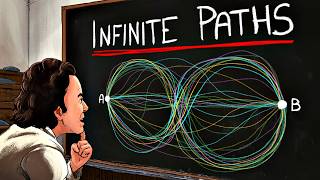
The Misconception of Single Paths
0:00 - 0:17
The presenter introduces his initial belief that objects follow a single path through space.
Single Trajectory
Initial Belief
Physics Misconception
Exploring All Possible Paths
0:17 - 0:38
The video introduces the idea that everything explores all possible paths simultaneously.
All Possible Paths
Quantum Exploration
Challenging Assumptions
Optimal Path Analogy
0:38 - 1:16
An analogy of finding the fastest path to rescue a swimmer is used to illustrate the concept of optimization.
Optimal Path
Rescue Analogy
Fastest Route
Light's Path and the Illusion of Trajectories
1:16 - 2:34
The presenter discusses how light seems to take the fastest path and how this leads to the illusion of well-defined trajectories.
Light'S Path
Illusion of Trajectories
Quantum Particles
The Quantum of Action and Blackbody Radiation
This module covers the concept of action, its historical development, and its crucial role in the bi...
This module covers the concept of action, its historical development, and its crucial role in the birth of quantum mechanics, particularly in resolving the blackbody radiation problem.
Introducing Action
2:34 - 3:12
The module introduces the concept of action and its historical development by Maupertuis and Hamilton.
Action Definition
Maupertuis
Hamiltonian Mechanics
The Blackbody Radiation Problem
3:25 - 5:08
The module describes the historical context of electric lighting and the problem of blackbody radiation.
Blackbody Radiation
Electric Lighting
German Research
Standing Waves and the Ultraviolet Catastrophe
5:08 - 6:49
The module explains the theoretical model of standing waves inside a cavity and the resulting ultraviolet catastrophe.
Standing Waves
Ultraviolet Catastrophe
Rayleigh-Jeans Law
Planck's Solution: Quantization of Energy
6:49 - 8:27
The module details Max Planck's revolutionary solution of quantizing energy to resolve the ultraviolet catastrophe.
Max Planck
Energy Quantization
Planck'S Constant
Implications of Energy Quantization
8:27 - 11:01
The module explains how energy quantization resolves the blackbody spectrum and introduces the concept of the quantum of action.
Blackbody Spectrum
Quantum of Action
Historical Significance
Quantization and Wave-Particle Duality
This module explores the development of quantum theory through the contributions of Einstein, Bohr, ...
This module explores the development of quantum theory through the contributions of Einstein, Bohr, and de Broglie, highlighting the concepts of quantization and wave-particle duality.
Einstein and the Photon
11:01 - 11:24
Einstein's contribution of the photon concept and its implications.
Albert Einstein
Photons
Discrete Packets
The Photoelectric Effect
11:24 - 11:44
Explanation of the photoelectric effect and its connection to quantization.
Photoelectric Effect
Frequency Threshold
Electron Ejection
Bohr's Atomic Model
11:44 - 13:06
Niels Bohr's model of the atom and the quantization of angular momentum.
Niels Bohr
Atomic Model
Angular Momentum
Quantized Angular Momentum
13:06 - 13:31
The ad hoc nature of Bohr's quantization and its successful prediction of the hydrogen spectrum.
Quantized Momentum
Hydrogen Spectrum
Ad Hoc Quantization
De Broglie's Hypothesis
13:31 - 15:19
Louis de Broglie's hypothesis of matter waves and its connection to Bohr's quantization condition.
Louis De Broglie
Matter Waves
Standing Waves
Feynman's Path Integral Formulation
This module explains Feynman's path integral formulation of quantum mechanics, demonstrating how par...
This module explains Feynman's path integral formulation of quantum mechanics, demonstrating how particles explore all possible paths and how constructive interference leads to observed trajectories.
The Double Slit Experiment and Infinite Paths
15:19 - 18:09
The double-slit experiment is used to illustrate the concept of particles exploring all possible paths, including a thought experiment with infinite slits.
Double Slit Experiment
Infinite Slits
Possible Paths
Implications of Exploring All Paths
18:09 - 18:42
Discussion of the implications of particles exploring all possible paths, including those that seem physically impossible.
Impossible Paths
Speed of Light
Quantum Connections
NordVPN Advertisement
18:42 - 19:59
A brief advertisement for NordVPN.
Nordvpn
Advertisement
VPN Benefits
Feynman's Approach: Summing Amplitudes
19:59 - 21:15
Explanation of Feynman's method of summing amplitudes for all possible paths to determine the probability of a particle's trajectory.
Summing Amplitudes
Probability
Feynman'S Method
Phase and Action
21:15 - 23:43
The concept of phase is introduced, and its relationship to action is explained.
Phase
Action
Stopwatch Analogy
Constructive and Destructive Interference
23:43 - 26:02
Explanation of how constructive and destructive interference of paths leads to the observed trajectories.
Constructive Interference
Destructive Interference
Path of Least Action
Experimental Demonstration of Quantum Paths
This module presents an experimental demonstration showing that light takes unexpected paths, suppor...
This module presents an experimental demonstration showing that light takes unexpected paths, supporting the idea that light explores all possible paths.
The Mirror and Light Paths
26:15 - 27:00
Introduction to the experiment using a mirror and light to demonstrate the concept of light taking multiple paths.
Mirror Experiment
Light Paths
Angle of Reflection
Blocking the Expected Reflection
27:00 - 27:50
Demonstration of blocking the expected reflection point and the prediction that light should still reflect elsewhere.
Blocking Reflection
Diffraction
Feynman'S Prediction
Using a Diffraction Grating
27:50 - 28:57
Use of a diffraction grating to create multiple reflection points, demonstrating that light takes unexpected paths.
Diffraction Grating
Multiple Reflections
Experimental Results
Laser Experiment
28:57 - 31:20
A laser is used to further demonstrate that light takes unexpected paths, even when the direct path is blocked.
Laser Experiment
Unexpected Paths
Experimental Verification
The Importance of Action in Physics
This module concludes by emphasizing the importance of action in modern physics and its role in the ...
This module concludes by emphasizing the importance of action in modern physics and its role in the search for a theory of everything.
Action as a Fundamental Principle
31:20 - 32:09
Discussion of the importance of action and the principle of least action in physics.
Action Principle
Fundamental Physics
Theoretical Physics
Lagrangian and the Laws of Physics
32:09 - 32:47
Explanation of how the Lagrangian and action can be used to derive the laws of physics.
Lagrangian
Laws of Physics
Mathematical Framework
The Search for a Theory of Everything
32:47 - 32:56
The module concludes by discussing the role of action in the search for a theory of everything.
Theory of Everything
Lagrangian
Mathematical Structure
Questions This Video Answers
What is the core idea presented in the video?
The video's central idea is that quantum particles, unlike classical objects, explore all possible paths between two points simultaneously. The path we observe is the result of constructive interference between these paths, governed by the principle of least action.
How does the principle of least action relate to quantum mechanics?
The principle of least action determines the phase of a particle's wave as it travels along a path. Paths with actions close to the minimum interfere constructively, making them the most probable paths. This explains why classical mechanics, which assumes a single path, emerges from quantum mechanics.
What is the significance of Planck's constant?
Planck's constant (h) is the quantum of action. It dictates the scale at which quantum effects become significant. Because it is so small, the actions of macroscopic objects are much larger than h, leading to the classical behavior we observe.
How does the video demonstrate that light explores all possible paths?
The video demonstrates this through an experiment using a mirror and a diffraction grating. By blocking the classically predicted reflection point, the presenter shows that light still reflects at other angles due to the constructive interference of paths that would normally cancel out.
What is Feynman's path integral formulation?
Feynman's path integral formulation of quantum mechanics states that to calculate the probability of a particle going from one point to another, you must sum over all possible paths the particle could take, weighting each path by a factor related to its action.
Why don't we see macroscopic objects taking all possible paths?
For macroscopic objects, the action associated with their motion is much larger than Planck's constant. This means that the phases of paths that deviate significantly from the path of least action oscillate rapidly and cancel out, leaving only the path of least action as the dominant one.
People Also Asked
Related Videos
Want to break down another video?
Break down another video